COLA · covered outdoor learning areasAn outdoor space you can timetable.
Start with what the school needs to keep doing outside. The right cover follows from that.

COLA means Covered Outdoor Learning Area. It is a covered, open-sided school space used for lessons, assemblies, play or sport. The useful question is what it must protect: a lunchtime seating area needs different cover from a court expected to work in the rain.
Choose the job before the roof
Keep a class or assembly dry
Specify the rain cover, the drainage and the area that actually stays dry. Open sides still let wind-driven rain in, so the dry patch is smaller than the roof above it.
Shade a busy play yard
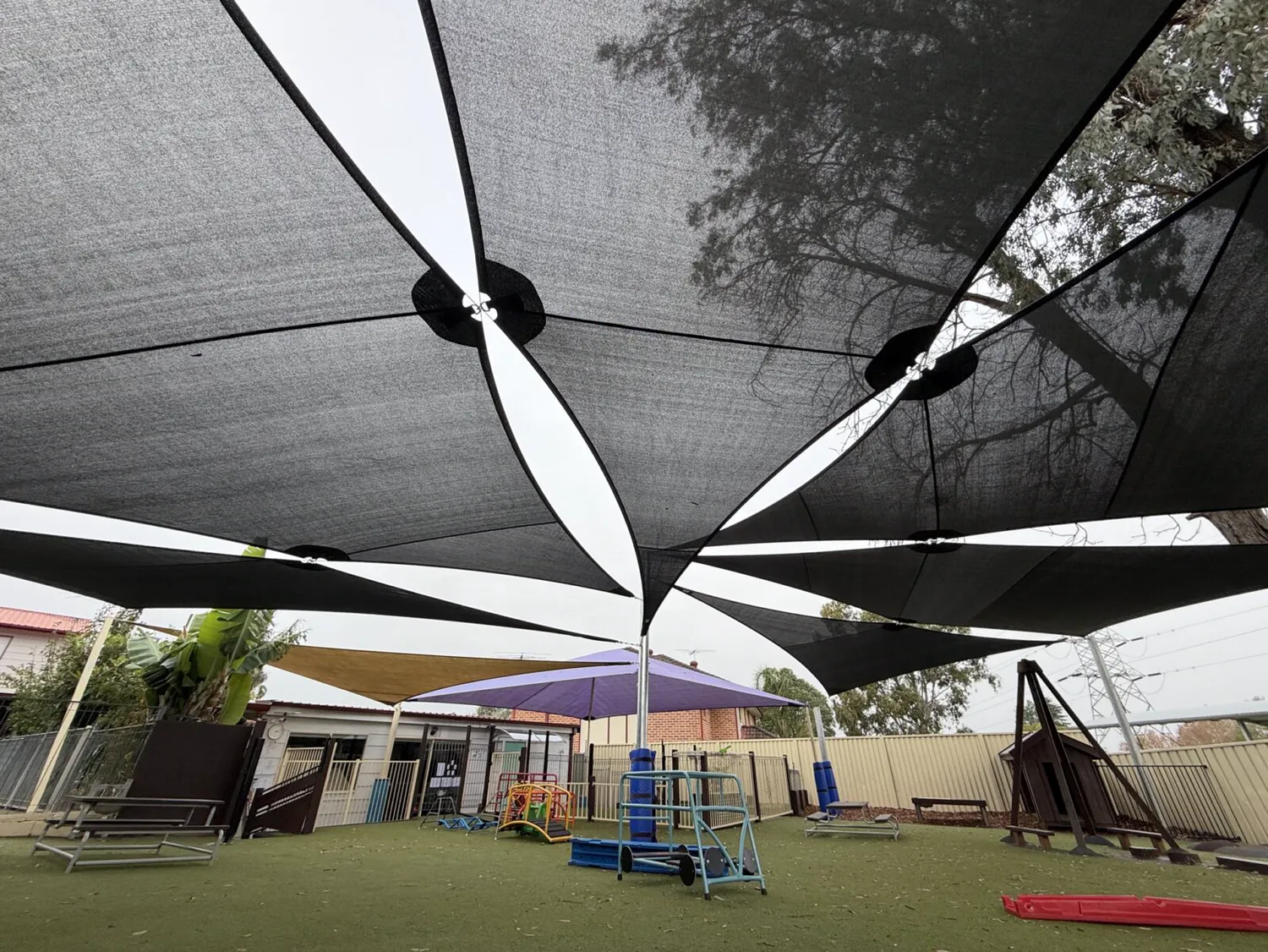
A breathable sail layout may suit the activity and existing equipment. Ordinary knitted shade cloth lets water through, so it cannot deliver the same wet-weather brief.
Keep a route or court clear
Show where people move and where games need clear space. Post locations are a design constraint from the first sketch.
A COLA is the space, not one roof shape
The term describes its use. The cover can be a framed roof or a suitably designed membrane structure. If someone proposes shade cloth when the brief says “wet-weather teaching”, resolve that mismatch before choosing colours. Our cloth versus waterproof PVC guide explains the material difference.

A frame can organise cover around a rectangular activity area. Several tensioned sails can work around an irregular yard. A cantilever can leave one side more open. The span and the footings come off the engineer’s design for the site, whichever arrangement you pick.
Try this before the first drawing
A ten-minute brief for the school team
Name a normal activity
“Year 2 eats lunch here” is a clearer starting point than “cover the courtyard”. Add when it happens and how many people must fit.
Mark the space that must stay clear
Include court run-off, accessible routes, doors, equipment and the canteen queue. Ask the staff who supervise this area to check it.
Choose the weather expectation
Write down whether the activity must continue during rain, or whether the priority is useful shade during hot, sunny periods.
For example, a canopy centred neatly over the paving can still miss a lunch queue that forms along the western edge. Stand in the space at lunchtime and mark where people actually wait. That observation can change the drawing more than an extra metre of fabric.
The less visible parts of a useful COLA
- The sun at the right time. Ask how the proposal shades the occupied area across the periods you need it.
- Water after rain. Identify where runoff goes, including beside doors and accessible paths.
- Teaching conditions. Consider sightlines, glare and whether a teacher can be heard during the intended activities.
- Ground and access. Supply service plans and identify the route for installation equipment.
- Future care. Leave access to inspect, clean and eventually renew the covering.
Built shade is one part of sun protection. Cancer Council NSW’s school-shade guidance covers reflected UV and encourages designs that children actually use.
Who approves it, and where does funding fit?
NSW public schools should start with the Department’s project-proposal process and confirm the applicable planning pathway. The landowner, project authority and funding body may need different information. We hold builder’s licence 294924C, which is usually the first thing an asset team asks for. See school shade funding for a dated shortlist of programmes.
Is a COLA the same as a shade sail?+
They are different scales of the same idea. A shade sail is one tensioned panel of fabric. A COLA is the whole covered space, and covering a court usually takes several overlapping sails or a framed roof. Schools and departments say COLA; builders and councils are more likely to say school shade structure, and they mean the same space.
Do we need council approval for a school COLA?+
In our experience of ordinary home enquiries, almost never. What decides it is the size, the height, where it sits and the land it stands on, which is why a school is the site type where those four often push the answer the other way. Some go ahead with no formal application; others want approval and structural certification. Start with the rules for your own site.
Can a COLA be built during term time?+
Yes, and plenty are. The noisy, heavy parts suit the holidays, and the rest can be staged behind hoarding on an agreed access route. Settle the route, the storage spot and the working hours with the school before anything is booked, because those three decide how the work has to be broken up.
If you want a second pair of eyes on the space
Free measure, blueprint and quote, seven days a week, Sydney and all of NSW.